
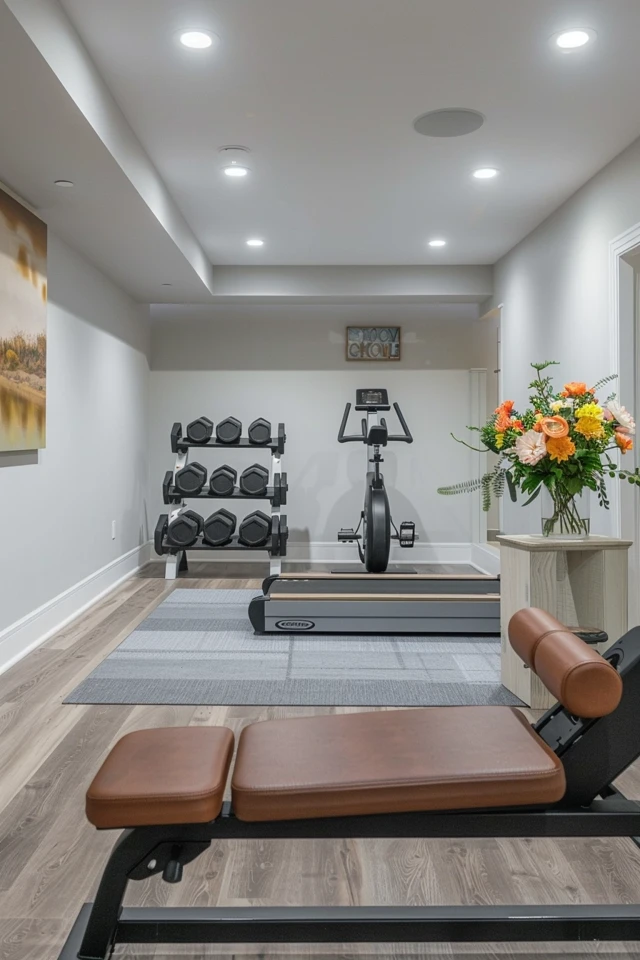
Title: Transform Your Space: Unfinished Basement Home Gym Ideas
1) Introduction
An unfinished basement often looks like a place for storage boxes and forgotten holiday decorations, not a sanctuary for health and wellness. However, looking past the concrete floors and exposed floor joists reveals incredible potential. The raw, industrial aesthetic is actually trending in interior design right now, making it the perfect backdrop for a serious workout space.
I remember walking into a client’s basement in Chicago a few years ago. It was dark, smelled slightly musty, and had wires hanging from the ceiling. They wanted to drywall the whole thing, but their budget was tight. We decided to lean into the “warehouse gym” look instead, saving them thousands of dollars while creating a space that felt gritty and motivating.
You do not need a full renovation to get a high-functioning home gym. With the right lighting, flooring choices, and spatial planning, you can create a professional-grade environment. Check out the photo gallery at the end of this post for visual inspiration on unfinished basement transformations.
2) Mastering the Climate and Environment
Before we move a single dumbbell, we have to address the “basement” element of the room. Unfinished spaces are often prone to moisture and poor air circulation. If you skip this step, your expensive equipment will rust, and the room will feel too heavy for a good cardio session.
Moisture Control
Concrete is porous. Even if you don’t see standing water, moisture vapor moves through the foundation.
- The Tape Test: Tape a 2-foot square of plastic sheeting to the floor and leave it for 48 hours. If the concrete is dark or there are droplets on the plastic when you peel it back, you have a moisture issue.
- Dehumidifiers: For a standard 1,000-square-foot basement, I usually recommend a 50-pint dehumidifier with a continuous drain hose running to your floor drain. This prevents you from having to empty a bucket daily.
Temperature Regulation
Basements stay cool, which is great for lifting but terrible for yoga or warm-ups.
- Space Heaters: If you don’t have HVAC drops, look for an oil-filled radiator heater. They are safer and quieter than fan-forced heaters.
- Airflow: Stagnant air makes a workout miserable. Install a heavy-duty wall-mounted fan or a high-velocity floor fan to keep air moving.
Designer’s Note:
The biggest issue I see in basement gyms is rust on expensive Peloton bikes or barbells. This happens because of humidity. Keep your humidity levels between 40% and 50%. Buy a cheap hygrometer (about $10) and keep it on a shelf. If it reads over 55%, your gear is at risk.
3) Flooring Solutions for Concrete Slabs
You absolutely cannot work out directly on concrete. It is terrible for your joints and will destroy your equipment if dropped. However, in an unfinished basement, you need flooring that can “breathe” or tolerate potential moisture.
Rubber Flooring Rolls (The Gold Standard)
This is what commercial gyms use. It is durable, looks seamless, and protects the slab.
- Thickness: Aim for 8mm (approx 5/16 inch) as a minimum for general fitness. If you are doing heavy Olympic lifting, bump that up to 3/8 inch or 1/2 inch.
- Material: Look for recycled rubber with EPDM granules. The EPDM adds color but also binds the rubber better.
- Installation: Rolls are better than tiles because they have fewer seams for sweat and water to seep through. Use double-sided carpet tape to secure the edges, but you can often loose-lay the center if the roll is heavy enough.
Horse Stall Mats
This is the budget-friendly favorite for heavy lifters.
- Size: Typically 4 feet by 6 feet and 3/4 inch thick.
- Pros: Indestructible and cheap (usually under $50 per mat).
- Cons: They smell like sulfur for the first few weeks. You must let them off-gas outside or in a garage for at least two weeks before bringing them indoors.
What to Avoid
Do not use standard carpet. It traps dust, mold, and sweat. Avoid “peel and stick” vinyl tiles directly on concrete, as the adhesive often fails when the concrete temperature fluctuates.
Common Mistakes + Fixes
Mistake: Buying cheap foam puzzle tiles from a department store.
Fix: Foam compresses too much. It becomes unstable during squats and shreds under heavy treadmills. Stick to high-density rubber.
4) Lighting: Banishing the Dungeon Vibe
Lighting is the single most important factor in making an unfinished basement feel intentional rather than accidental. Exposed joists “eat” light because the shadows get trapped between the beams. You need significantly more lumens here than in a finished room with white drywall.
Color Temperature Matters
Avoid “Warm White” (2700K) bulbs. They make a basement look yellow and dingy.
Aim for “Bright White” or “Daylight” (4000K to 5000K). This spectrum mimics natural sunlight and keeps energy levels high.
Lighting Fixture Options
Since you have exposed joists, you have easy mounting points.
- String Lights: For a softer, bistro-style look, heavy-duty string lights (Edison bulbs) draped in a zigzag pattern work well. This is less functional for high-intensity training but great for yoga zones.
- LED Shop Lights: These are lightweight, plug into standard outlets, and are incredibly bright. You can chain them together. Zip-tie them directly to the joists or hang them on short chains to clear any ductwork.
- Track Lighting: If you have electrical boxes already installed, track lighting allows you to aim beams at specific zones (like the squat rack or the mirror) while leaving other areas dimmer.
Paint the Ceiling?
If you want to maximize light, rent a sprayer and paint the entire ceiling (pipes, wires, and wood) a flat white. This reflects light down and makes the ceiling feel higher. If you prefer the moody, industrial vibe, paint it Matte Black (specifically “Dryfall” paint). Just know that black ceilings require 30% to 50% more lighting fixtures to keep the room bright.
5) Layout and Zoning for Functionality
In an open, unfinished basement, clutter is the enemy. Without walls to define spaces, equipment tends to migrate. You need to create “zones” based on activity.
The Cardio Zone
Cardio machines often require power. Place them near existing outlets to avoid running extension cords across the floor, which is a major trip hazard.
- Clearance Rules: Leave at least 20 inches of clearance on either side of a treadmill and 6 feet of open space behind it. This is a crucial safety standard in case you fall off the belt.
- Headroom: Basements often have low clearance or hanging HVAC ducts. Measure your ceiling height at the lowest point (the duct). A runner on a treadmill bounces up about 4 to 6 inches. Ensure you have at least 12 inches of head clearance above the user’s standing height on the machine.
The Strength Zone
Heavy items like racks and benches should go on the most level part of the floor.
- Spacing: Allow a 3-foot perimeter around a weight bench or squat rack. You need room to load barbells and for a spotter to stand safely.
- Mirror Placement: Mirrors are functional, not vanity. Place a large mirror (at least 36 inches wide) in front of your lifting zone. Mount it so the bottom edge is 24 inches off the floor. This allows you to see your squat depth without wasting glass on your shins.
The Floor Work/Recovery Zone
Keep this away from the high-traffic path. Place your yoga mats and foam rollers here.
Real Project Checklist:
When I plan a layout, I use blue painter’s tape on the floor to outline every piece of equipment before buying it. Walk through the “taped” workout. Do you hit your elbow on the furnace when you do a pushup? Adjust the tape now, not the heavy machine later.
6) Styling: The “Industrial Chic” Aesthetic
Since we aren’t hiding the raw elements, we need to style them. The goal is to make the unfinished nature of the room look like a design choice.
Wall Treatments (Without Drywall)
You don’t need to stud and drywall the perimeter.
- Curtains: Install a ceiling-mounted curtain track to hide ugly areas like the water heater or storage bins. Use heavy canvas drop cloths as curtains for a neutral, textural look that is very affordable.
- Whitewash Brick/Concrete: If you have poured concrete walls, seal them and paint them white. It instantly cleans up the look.
- OSB or Plywood: If you need to mount things but can’t drill into concrete, screw a sheet of sanded plywood into the floor joists (anchored at the top) and the floor (anchored at the bottom). It creates a warm wood accent wall perfect for hanging bands or mounting a TV.
Decor and Motivation
- Neon Signs: A bright LED neon sign pops incredibly well against a dark or concrete background. It adds a focal point.
- Plants: Since there is likely no natural light, invest in high-quality faux plants. A large faux Fiddle Leaf Fig or Snake Plant softens the harsh concrete lines.
- Organization: Use metal shelving units (like wire racking). They match the industrial vibe and allow airflow around your towels and equipment.
7) Final Checklist: What I’d Do in a Real Project
If I were consulting on your basement gym tomorrow, this is the exact order of operations I would follow to ensure success:
Phase 1: Prep
- Clear the entire space. Sweep and vacuum the rafters (cobwebs fall when you start jumping rope).
- Run the “Tape Test” for moisture on the concrete.
- Install a dehumidifier and set it to 45%.
Phase 2: Base
- Lay down 8mm rubber flooring rolls. Tape the seams.
- Secure loose wires in the ceiling using cable staples.
- Install LED shop lights (4000K temp) evenly spaced to eliminate shadows.
Phase 3: Install
- Place the heaviest equipment first (Racks/Cardio).
- Check clearances: Is the barbell going to hit the water pipe?
- Mount mirrors securely to the concrete wall (use Tapcon screws) or hang them from the joists using heavy chains.
Phase 4: Style
- Add a large floor fan.
- Set up a sound system (Bluetooth speaker on a shelf).
- Add storage hooks for bands and belts.
8) FAQs
Q: Is it safe to drill into my concrete floor for a squat rack?
A: Generally, yes. Most residential basement slabs are 4 inches thick. Use a hammer drill and concrete anchors. However, be aware of in-floor radiant heating or plumbing lines. If your home is newer, check your blueprints first.
Q: How do I stop the gym from smelling like a basement?
A: The “basement smell” is mold and mildew caused by humidity. The dehumidifier is your first line of defense. Secondly, remove cardboard boxes from the room—cardboard absorbs moisture and breeds mold. Switch to plastic bins.
Q: Can I put a heavy treadmill on a floating floor?
A: Yes, but solid rubber is best. If you use interlocking foam, the treadmill will “walk” or sink. Always place a dedicated equipment mat under the treadmill to catch lubricant drips and protect the rubber flooring from indentations.
Q: It’s too cold in the winter. What is the best heating option?
A: Infrared heaters are excellent for gyms. They heat objects (and bodies) rather than just the air. You can mount an infrared heater on the wall or ceiling, saving floor space.
9) Conclusion
Transforming an unfinished basement into a home gym is one of the most practical uses of square footage in a home. You do not need to wait for a budget that allows for studs, insulation, and drywall. In fact, the raw nature of the basement often fosters a “work hard” mentality that a polished room can’t replicate.
By focusing on the fundamentals—moisture control, proper rubber flooring, and bright lighting—you turn a dark storage area into a high-performance zone. Start with the floor and the lights. Once those are in, the rest is just arranging your toys.
10) Picture Gallery


