
Modern French Country Bathroom Design Ideas
There is a specific kind of magic that happens when you blend the rustic warmth of the French countryside with the clean, edited lines of modern design. It creates a space that feels timeless yet current, and lived-in but uncluttered. You can find the full Picture Gallery at the end of this blog post to see these concepts in action.
I remember working on a master bath renovation for a couple who were torn between two very different aesthetics. One wanted the romance of a clawfoot tub and floral wallpaper, while the other wanted industrial steel doors and concrete floors. The compromise was Modern French Country. It allowed us to layer textures like raw wood and unlacquered brass against a backdrop of crisp white walls and modern plumbing fixtures.
This style is not about reproducing a farmhouse look from a century ago. It is about taking the best elements of that era—durability, natural materials, and craftsmanship—and applying them to how we live today. In this guide, I will walk you through the practical steps to achieving this balance, covering everything from layout logistics to the final styling details.
1. The Foundation: Selecting Materials and finishes
The success of a Modern French Country bathroom relies almost entirely on your material palette. Unlike stark modernism, which often relies on synthetics, this style demands authenticity. You want materials that will patina and age gracefully over time.
I always start with the floor. Natural stone is the gold standard here. Tumbled limestone or honed travertine offers that earthy texture that grounds the space immediately. If you are working with a tighter budget, look for high-quality porcelain tile that mimics stone with significant variation in the print. Uniformity is the enemy of this aesthetic.
For the walls, we want to avoid the “drywall box” effect. Texture is key. Consider vertical shiplap (often called V-groove) painted in a creamy off-white or a soft “greige.” This adds architectural interest without feeling too nautical. Alternatively, applying a lime wash paint can give the walls a suede-like texture that feels very European.
Designer’s Note: The “Living” Finish
One lesson I learned early in my career involved specifying polished chrome fixtures in a rustic bathroom. They looked too new and sterile. For this style, I almost exclusively use unlacquered brass or polished nickel. Unlacquered brass is a “living finish,” meaning it will darken and spot with water use. This is desirable. It adds character. If you hate the idea of tarnish, stick to polished nickel, which has a warmer undertone than chrome but stays shiny.
Hard Finish Coordination Guide
- Flooring: Tumbled limestone, terracotta in muted tones, or matte porcelain stone-look tile.
- Wall Tile: Zellige tile (Moroccan handmade tile) is perfect because of its irregular edges and surface imperfections.
- Countertops: Carrara marble (honed, not polished) or soapstone. Quartz is an option, but choose a matte finish to avoid a plastic look.
- Grout: Avoid bright white grout. Use a warm gray or “biscuit” color to hide dirt and soften the grid lines.
2. The Vanity: Furniture-Style vs. Built-In
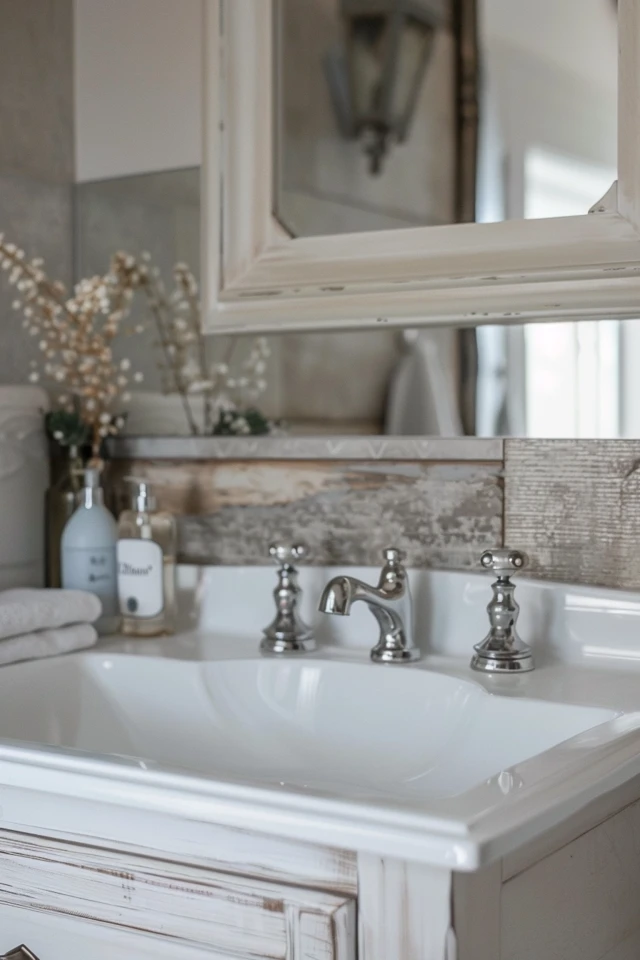
In a standard modern bathroom, you might see a floating vanity. In a French Country bathroom, the vanity should look like a piece of furniture. This anchors the room and adds a sense of history. We want the piece to look like it was inherited, not purchased from a big-box store catalog.
Converting an antique dresser or sideboard into a vanity is a classic move. You cut a hole for the sink and seal the wood heavily with marine-grade varnish. However, this comes with challenges. Drawers often need to be modified to accommodate the P-trap plumbing underneath, which reduces storage.
If you need maximum storage (a realistic constraint for families), I recommend a custom built-in that features “inset” cabinetry rather than “overlay.” Inset cabinets have doors that sit flush inside the frame, a hallmark of fine carpentry. Add feet to the bottom of the toe kick to mimic the look of a freestanding furniture piece.
Measurements and Spacing Rules
When planning your vanity layout, scale is critical. Here are the numbers I use on site:
- Vanity Height: Standard vintage furniture is often 30-32 inches high, which is too low for modern standards. Aim for a finished height of 34-36 inches (including the countertop).
- Sconce Placement: If flanking a mirror, mount sconces roughly 60-66 inches from the floor to the center of the junction box. This places the light at eye level for most people, reducing shadows.
- Clearance: Ensure you have at least 30 inches of clear walkway space in front of the vanity. If you have drawers, you need full extension space plus room to stand.
3. The Wet Zone: Tubs and Showers
The bathtub is often the focal point of a French Country design. A freestanding tub is the archetype. While a traditional clawfoot is beautiful, it can be a pain to clean under. For a modern twist, I often use a freestanding tub with a solid skirt or a pedestal base. It provides the same silhouette but with cleaner lines and easier maintenance.
For the shower, ditch the heavy fiberglass pans. We want a curbless entry or a very low-profile stone curb if possible. The enclosure itself drives the “Modern” part of the design. I prefer frameless glass enclosures to let the tile work shine. If you want a stronger statement, a steel-grid glass door (reminiscent of an old factory window) creates a fantastic contrast against rustic stone.
Common Mistakes + Fixes
Mistake: Designing a “wet room” (tub inside the shower area) without proper slope.
Fix: Wet rooms are great for saving space, but water management is tricky. Ensure your contractor slopes the floor 1/4 inch per foot toward the drain. Also, verify that your waterproofing membrane (like Schluter-Kerdi) extends up the walls and across the entire floor.
Mistake: Using slippery tile on the shower floor.
Fix: Large format tiles look great on walls but are dangerous underfoot when wet. Use a mosaic tile (2 inches or smaller) for the shower floor. The high ratio of grout lines provides necessary traction.
4. Lighting and Hardware: The Jewelry of the Room
Lighting is where many homeowners ruin a perfectly good design. You cannot rely on a single overhead recessed can light. That creates harsh shadows that make you look tired and the room look clinical. You need layers.
Start with eye-level lighting at the vanity. Sconces with fabric shades add a distinct “living room” feel to the bathroom, which is very French Country. The fabric softens the light and adds texture. Just ensure the location isn’t too close to splashing water, or check that the fixture is damp-rated.
For the overhead fixture, a vintage crystal chandelier or a simple lantern pendant works well. This adds vertical interest. If you are in a rental or have a low ceiling, a flush mount with an antique brass finish and milk glass shade is a safe, stylish bet.
The Rules of Metals
Mixing metals is allowed and encouraged, but there is a logic to it. I usually stick to a dominant metal and an accent metal.
- Dominant Metal (approx. 70%): Faucets, shower heads, and large towel bars. (e.g., Polished Nickel).
- Accent Metal (approx. 30%): Cabinet knobs, light fixtures, and mirror frames. (e.g., Unlacquered Brass or Matte Black).
Avoid mixing two similar metals, like Brushed Nickel and Chrome. They look like a mistake. You want high contrast between your metals so the difference looks intentional.
5. Textiles and Styling: Adding Softness
This is the step that transitions a bathroom from a construction project to a home. Modern French Country relies heavily on textiles to soften the hard surfaces of stone and tile.
Swap out the standard terry cloth bath mat for a vintage runner rug. Turkish or Persian rugs in faded reds, blues, and creams hide dirt incredibly well and add warmth. Don’t worry about water; wool is naturally resilient. Just hang it over the tub to dry if it gets soaked.
For window treatments, avoid aluminum blinds. Go for relaxed Roman shades in linen or ticking stripe fabric. If you have privacy glass and don’t need full coverage, a “cafe curtain” (covering only the bottom half of the window) is quintessential French Country style. It lets light in while blocking the view from the street.
What I’d Do in a Real Project (Mini Checklist)
- Towels: I would choose waffle-weave towels in white or oatmeal. They dry faster and have better texture than plush loops.
- Accessories: I would place a small wooden stool next to the tub. It holds a book or a glass of wine and introduces wood grain to the wet area.
- Greenery: I always add a potted plant. An olive tree in a terracotta pot is ideal if you have light. If low light, a preserved eucalyptus bundle in a vase works perfectly.
- Storage: I would use woven seagrass baskets for extra toilet paper and towels. The natural fiber is a must-have texture.
Final Checklist
Before you commit to your renovation or refresh, run through this list to ensure you have hit the key markers of the Modern French Country style.
- Palette Check: Is your base palette neutral (creams, whites, warm greys) with colors introduced only through natural stones or textiles?
- Texture Audit: Do you have at least three different textures? (e.g., Smooth glass, rough wood, soft linen).
- Metal mix: Have you chosen a “living finish” like brass or nickel, or are you sticking to matte black for a modern edge? Avoid generic chrome.
- Lighting Layering: do you have sconces for tasks and a pendant/chandelier for ambience? Are they on dimmers?
- Wood Elements: Is there a wood element to warm up the room? (Vanity, stool, shelving, or mirror frame).
- Scale Verification: Have you taped out the vanity and tub on the floor to ensure flow?
FAQs
Can I do this style in a small bathroom?
Absolutely. In a small powder room, you can actually go bolder. I often suggest wrapping the room in wallpaper (a subtle floral or toile) or doing wainscoting halfway up the wall to draw the eye up. Use a pedestal sink to save floor space, but ensure you have a shelf or medicine cabinet for storage.
Is wood flooring safe for a bathroom?
I generally advise against real hardwood in a full bath with a shower/tub due to humidity and standing water issues. However, high-quality luxury vinyl plank (LVP) or wood-look porcelain tile has come a long way. If you choose wood-look tile, use the thinnest grout line possible (1/16 inch) and a matching grout color to make it look seamless.
How do I make this style look “Modern” and not messy?
The “Modern” aspect comes from editing. Avoid clutter. Keep countertops mostly clear. Choose a mirror with a simple, thin frame rather than an ornate, heavy carving. Keep the tile patterns simple—running bond (brick pattern) or stacked bond—rather than complex mosaics.
Is marble maintenance a nightmare?
It is not a nightmare, but it is a commitment. Marble will etch (dull spots) from acids like lemon in cleaning products or certain cosmetics. I tell clients to embrace the patina—it’s very French. However, you must seal it annually. If you want zero maintenance, choose a quartz that looks like marble, but be aware it lacks the depth of real stone.
Conclusion
Designing a Modern French Country bathroom is about striking a balance between the old world and the new. It is about honoring natural materials and simple craftsmanship while ensuring the space functions for a modern lifestyle. It allows you to have a space that feels sophisticated without feeling fragile.
Remember that this style thrives on imperfection. A slightly tumbled floor tile, a brass faucet that darkens with age, or a linen curtain that is slightly wrinkled—these are features, not bugs. Take your time selecting materials that feel good to the touch, and you will create a sanctuary that you will love for years to come.
Picture Gallery


